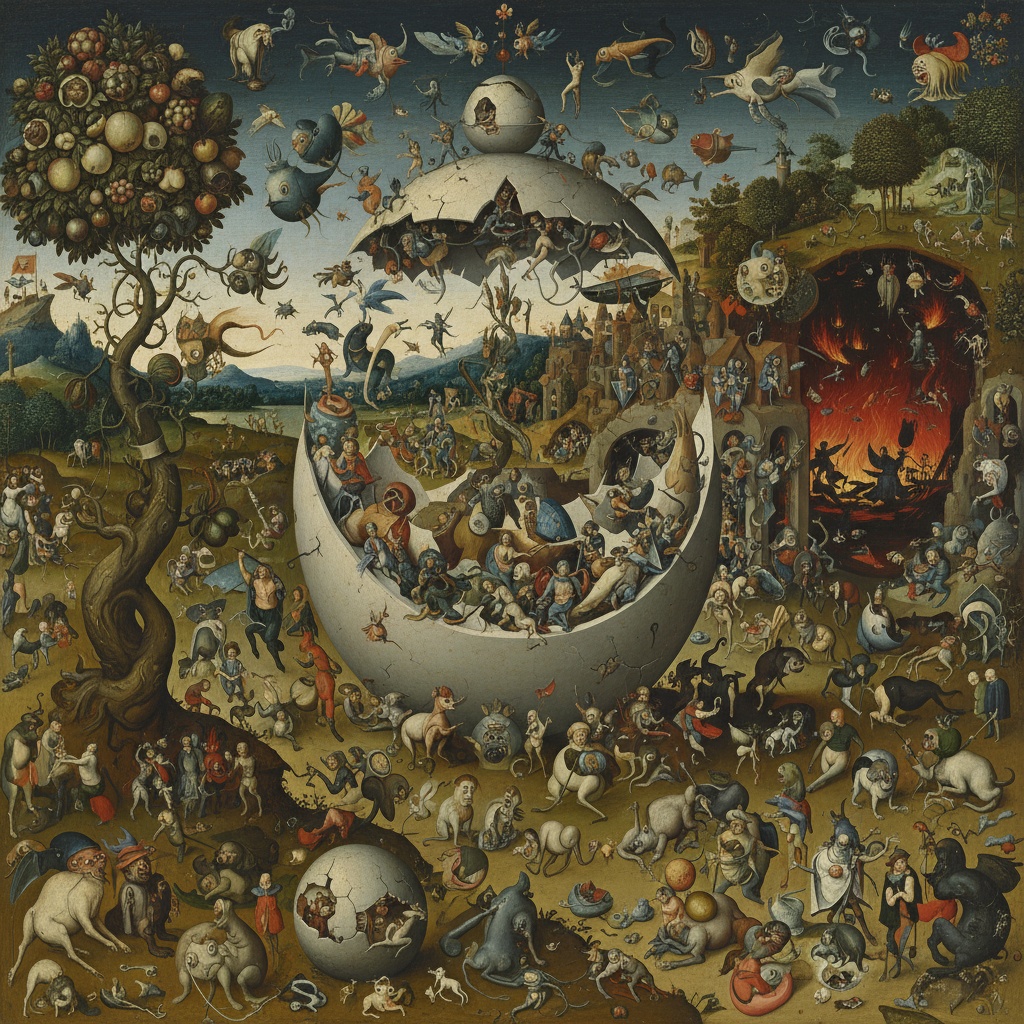
One day I reflected on financial bubbles and came to a precise conclusion: over time, the big bubbles seem to become even bigger at the moment they burst, at least if I look at the amount of money burned and the scale of the damage. Not because the market truly learns not to repeat itself, but because with each crisis new antibodies are born, new rules, new precautions; and yet the disease returns, more insidious, finding different routes to spread. The feeling, then, is not that of linear progress, but of a constant competition between memory and oblivion, between regulation and the adaptation of risk.
The first necessary correction, though, is simple: bubbles do not necessarily become bigger in absolute terms each time. If I measure the damage in nominal values, recent crises often seem much larger because the global economy is far bigger than it was a hundred years ago. If instead I look at ratios to GDP, private wealth, or market capitalization, the picture becomes less linear. 1929 remains an enormous historical trauma; 2000 destroyed a gigantic amount of stock-market value, but with macroeconomic consequences less devastating than 2008; that crisis, instead, showed how a bubble in credit and real estate can turn into a global systemic event.
This ability to push fragility outside banks is visible in the numbers from the Financial Stability Board: in 2024, nonbank financial intermediation accounted for 51% of global financial assets and was growing by 9.4%, twice the pace of the banking sector. The figure does not prove that a new crisis is imminent, but it makes the point concrete: a huge share of risk moves among funds, insurers, pensions, and other intermediaries. The regulatory antibodies introduced after 2008 improved some bank defenses; they did not make the whole system transparent.
The idea that more people are exposed to markets today can also be bounded by a single statistic. In the United States, the Federal Reserve’s Survey of Consumer Finances found in 2022 that stocks were held directly or indirectly by 58% of households, up from 53% in 2019 and 52% in 2016; direct ownership rose from 15% to 21% between 2019 and 2022. That is not enough to predict the size of the next crisis, and it does not describe the whole world, but it shows that a market drop can more easily make its way into family savings and pensions. When the crisis involves credit and real estate, contagion then reaches employment, consumption, and confidence.
There is also a cultural transformation within this evolution. The contemporary world appears more gamified, closer to gambling, more accustomed to rapid feedback and intermittent gratification. In this sense, the spread of crypto, retail trading, collectible cards, meme stocks, betting, and other speculative objects is not accidental. It is not just greed or collective stupidity. It also reflects the search for redemption, belonging, identity, a shortcut to economic ascent in a context that offers less security and less mobility than before. Risk is experienced as a normal, even entertaining, experience, and this lowers many psychological defenses.
The pandemic then acted as an accelerant. The combination of ultralow interest rates, central bank purchases, enormous fiscal stimulus, and forced savings created an unusual mass of liquidity. But it was not only a matter of money circulating: it was also a distortion of expectations. For a certain period, many learned to believe that the central bank would always support markets, that rates would stay low for a long time, that risk was somehow insured. That confidence was almost more powerful than liquidity itself. We still see the effects today: stretched valuations, misallocated capital, speculative habits that have left long tails and are hard to absorb.
In this framework, the idea of an artificial intelligence bubble is understandable but must be handled with caution. If a bubble is too obvious, it may already be partially priced in; and if everyone expects it, perhaps it is not the bubble one imagines. This objection is serious. Many times the market does not do the most obvious thing, and the shared narrative can even work as a contrary signal. But the reverse is also true: there are bubbles visible for years that burst only when the regime changes, when rates stay high longer than expected, when revenues do not grow as promised, when the cost of financing becomes unbearable.
If I looked at the issue through Taleb’s eyes, the question would not be so much whether AI is or is not a bubble. The real question would be another: where is asymmetric fragility accumulating? Who depends on an almost perfect scenario? Who can be ruined if the future does not follow the script? His view would move far from easy forecasts and close to leverage points, concentration, dependence on refinancing, and asymmetry of losses. In this sense, the risk is not only in recognizing a bubble; it lies in confusing the order of expectations with the reality of rare events.
Yet an important objection remains: the fact that the globalized world and the financial world have bet so much on AI is not necessarily insurance against a bubble. It may be the opposite. The more capital is already committed to the same theme, the stronger the incentive to support the narrative, to postpone recognizing losses, to keep valuations alive. That does not abolish fundamentals. If revenues do not come, the system is not saved by the mere will not to get hurt. Concentrated capital often makes a collapse slower, not impossible; and when the regime changes, the correction can become more violent precisely because so many positions are tied to the same story.
There is, however, a counter-reading that is even more interesting: AI is increasingly becoming a good of humanity, especially if open-weight models, including Chinese ones, lower prices and push toward commoditization. This observation should not be minimized. If access costs fall, if models become more powerful and widespread, if global competition compresses margins, a growing share of AI’s value shifts from proprietary scarcity to broad utility. In this scenario, one cannot say that all of AI is a bubble. The internet was real even when many dot-com companies were overvalued; electrification was real even when some firms were destined to disappear; the same applies here. The technology can be right and the price of many assets can still be wrong.
The real question, then, is not whether AI will exist or whether it will matter. That much is already obvious. The question is where the value will concentrate: in the model, in integration, in data, in the distribution channel, in compute, in trust, in compliance, in the ability to turn technical capability into profits. It is difficult to answer because the future is not written, and precisely for that reason I distrust valuations that behave as if it already were. We do not know who will win, which model will dominate, which companies will earn the best margins. But we can see who is heavily exposed to a single scenario, who must grow perfectly to justify the price, who depends on continuous capital, who has high costs and still uncertain revenues.
In the end, the strongest position is this: the future has yet to be written, but today’s prices often act as if almost everything were already decided. This is where bubbles truly arise, not only when a story is false, but when a plausible story is loaded with excessive certainty. That is why my initial idea must be kept, but corrected: bubbles are not always larger in a linear way, but the modern system is increasingly skilled at turning a bubble into a contagious and painful event. Antibodies exist, but they do not guarantee immunity. Often they only change the place where fragility hides, waiting to surface again.