I’d like to talk about the space economy because I’ve always been a lover of space and science fiction. I’ve always been drawn to probes, discoveries, the future glimpsed beyond the present, and precisely for that reason I’m struck by the way space is talked about today not only as exploration, but as an economic system capable of changing the world in the near future.
There is, however, one point that seems decisive to me: the revolution, if it arrives, may not appear as a single epic gesture. It may first arrive as an invisible, widespread, integrated economic infrastructure in everyday life. Data, connectivity, Earth observation, navigation, climate monitoring, new materials, and new services: that is where space stops being merely imagination and becomes a concrete part of the terrestrial present. In this sense, the space economy does not coincide with the romantic idea of “going into space,” but with the use of space as a platform that makes other things possible down here.
Over the course of my life, it seems plausible that I’ll see at least part of this transformation. I don’t know whether it will be a spectacular, visible, striking revolution, or a quiet one that changes how the world works without drawing too much attention. The second hypothesis seems even more realistic to me. And precisely for that reason, the space economy fascinates me: because it promises to change the material structure of things, not just our imagination.
At the same time, the doubt remains strong that human beings are truly suited to leave their planet. We are tied to Earth like a snail to its shell. Gravity is not a detail: it is a structural variable. A body evolved in 1g does not simply go elsewhere without consequences. Under different gravity, lower or higher, bones, muscles, circulation, balance, and development all change. The problem is not merely standing up on Mars or on the Moon; it is adapting the entire physiological system to a different context.
From this comes an important distinction. Saying that we are not made to abandon Earth does not mean saying we cannot adapt. It rather means that adaptation, today, seems to require complex technology and probably artificial habitats more than open planets. The most plausible path is not to live on Mars as we live on Earth, but to build closed, controlled, engineered environments that partially imitate Earthly conditions. Life in space, at least as I can imagine it, is not an escape from limits: it is the attempt to recreate an inhabitable limit.
Within this framework comes an even more concrete consideration: the biological body has a short lifespan, fragility, continuous needs, and above all a psychological vulnerability that should not be underestimated. For this reason, I find convincing the idea that the future of space exploration may depend less on transporting the human body and more on using artificial extensions: humanoid robots, teleoperated systems, mechanical avatars, perhaps brain-machine interfaces. In other words, humanity may reach other worlds not by truly relocating its organism, but by extending its presence through machines.
That hypothesis, however, opens up another problem. Exploring a planet through an artificial system is one thing; feeling that presence as truly human is another. Here the symbolic, emotional, and identity dimension comes into play. Human beings are not just a set of biological functions: they are lived experience, embodied memory, self-perception. Even if technology were able to replace many physical functions, it is not a given that it could replace the sense of being there. The future could be made of indirect, mediated presence, perhaps even more powerful operationally, but less immediate existentially.
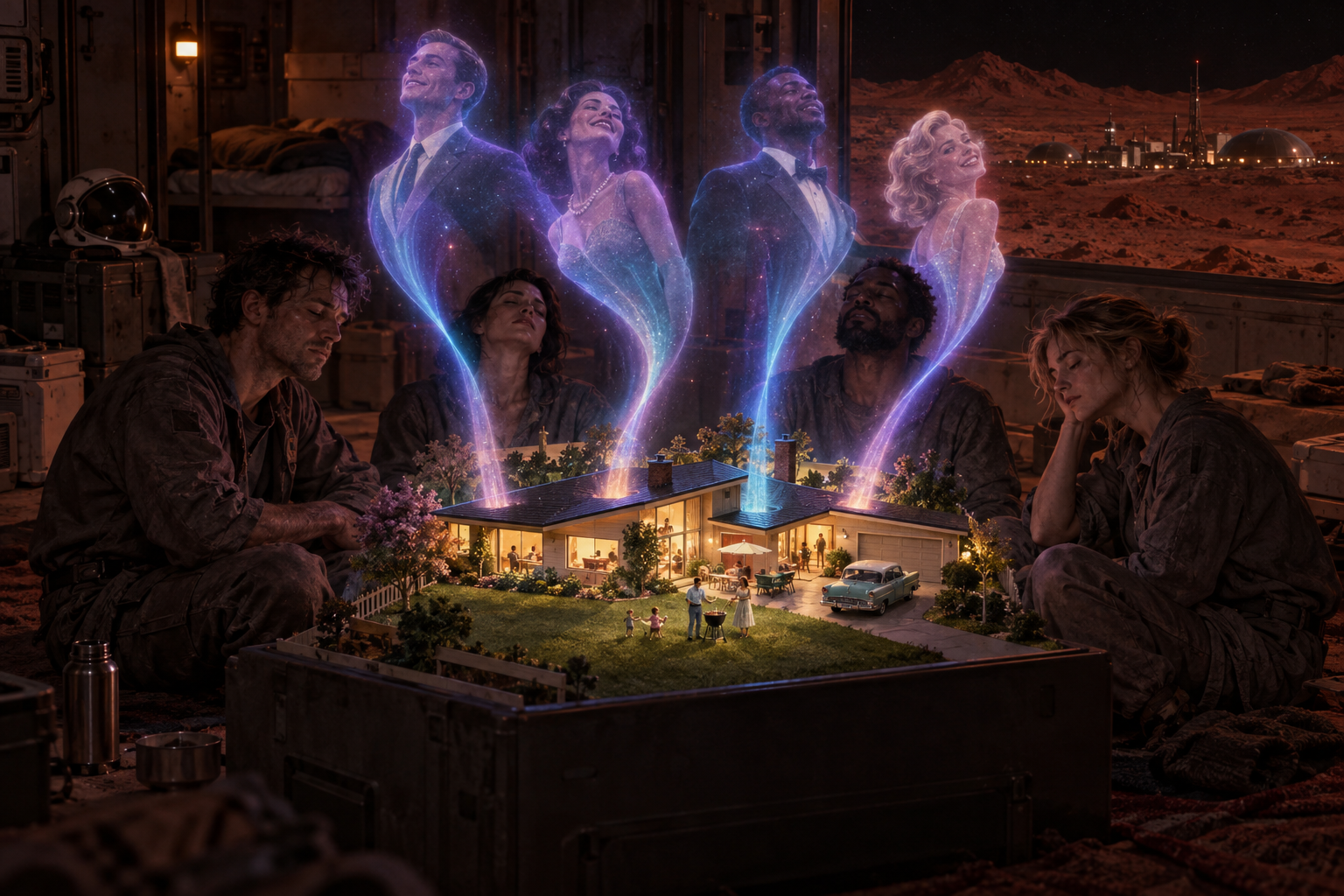
That is why the idea of living on Mars leaves me perplexed. In The Three Stigmata of Palmer Eldritch, Phillip K. Dick portrayed, in my view very incisively, a form of underground and artificial existence in which people take Can-D to enter highly detailed dollhouses and miniatures that reproduce the ideal life on Earth. That vision seems useful to me not because it “predicts” Mars, but because it captures a real risk: if the environment is poor, closed, hostile, then the need grows to retreat into simulations, surrogates, replacement worlds. Living on Mars, even in the best case, would probably not mean inhabiting another world in the romantic sense, but inhabiting a technical structure that protects against a hostile world.
Mars life, if it ever became real, would probably be underground or otherwise shielded, regulated by energy, recycling, and constant maintenance. It is not certain that it would be “worse” in absolute terms, but it is reasonable to think it would carry high psychological costs: isolation, environmental monotony, the constant pressure of survival, the loss of contact with a natural ecosystem. For that reason, the question is not only whether we can live on Mars, but what kind of life that would be, and above all what human desire would become in such a world-poor environment.
In terms of distance, too, realism requires distinctions. Mars is close only in a relative astronomical sense, and even there the challenge is enormous. The moons of Jupiter and Saturn are much farther away and more difficult; leaving the solar system with a human crew today belongs more to fantasy than to prediction. The distances are so great that the time scales are incompatible with human life and with current technology. Before even talking about colonies, cities, or autonomous extraplanetary civilizations, we have to ask whether there is enough historical and technical continuity to keep that possibility open. And even that is not guaranteed: climate, resources, wars, and instability could weigh on Earth itself.
For this reason, the most prudent hierarchy seems clear to me: first robotic exploration, then possibly a limited human presence, and only much later, perhaps, a truly independent civilization beyond Earth. But the most concrete hypothesis remains another one: the expansion of the species through machines and infrastructure, not through fully relocated biological bodies. It is an important shift, because it moves the discussion from colonization to technological mediation. Not so much “living elsewhere” as operating elsewhere.
And in the end there remains the simplest consideration, and the hardest one to ignore: Earth is a pale blue dot unlike almost anything else. We have not found another planet that we know to be truly similar to Earth in the strong sense of the term, with a compatible atmosphere, stable water, suitable temperature, adequate magnetic protection, and stable conditions over long periods. That does not mean it is certainly the only possible world, but it does mean that, as far as we know today, we do not have a ready-made replacement. And that is enough to treat it as something unrepeatable.
Perhaps that is exactly where the space economy meets the most human limit. We can imagine new development models, new infrastructures, new economies beyond orbit. We can even think of Mars as a technical horizon. But, at least for now, our real advantage remains Earth: the only environment that allows us to exist without a total machine around the body. And that is already a great deal.